
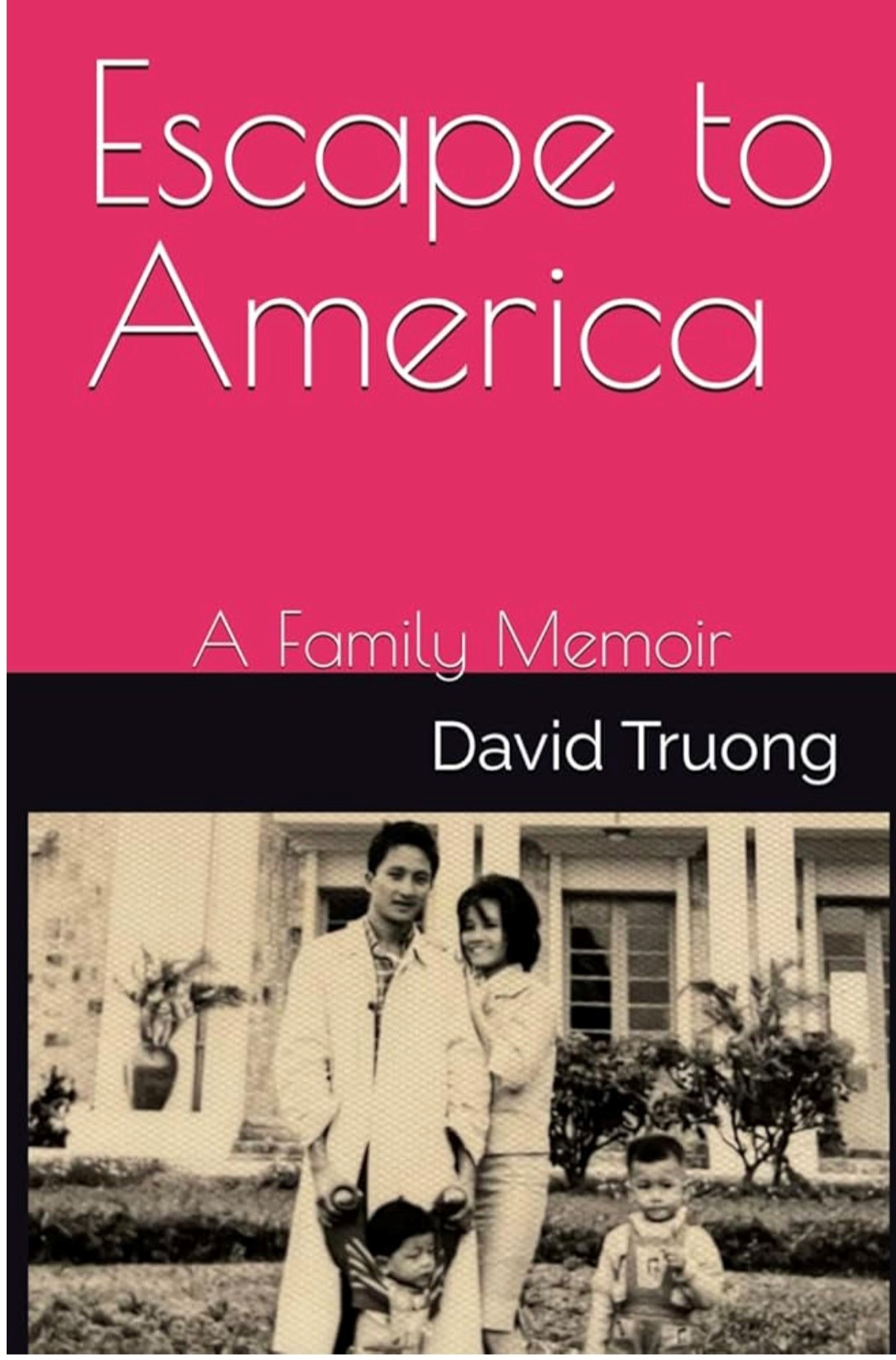
Escape to America: A Family Memoir


Escape to America – Chapter Summaries
Chapter 1 – A Country Boy Can Survive
The memoir begins with reflections on my upbringing in the U.S., in stark contrast to my Vietnamese roots. Chapter 1 introduces readers to the lead characters: a flawed but brilliant father, a mother’s enduring love, and the heroism of the two oldest sons, who would play principal roles in the escape.
Chapter 2 – The Fall of Saigon
This chapter recounts the days leading up to the collapse of South Vietnam, the family’s experience witnessing North Vietnamese tanks entering Saigon, and the drastic changes imposed by the Communist regime.
Chapter 3 – Hoc Tap (Re-Education Camp)
My father, a South Vietnamese Air Force officer, was sent to a re-education camp, enduring starvation, forced labor, and brutal conditions. His release was secured through family connections and his mother’s insistence. The experience deeply affected the family but also strengthened our resolve to escape Vietnam.
Chapter 4 – The Plan
My parents devised a plan to flee by sea, posing as a fishing family to avoid suspicion. The two eldest sons, Tuan and Tu, learned fishing and village life in Go Cong to blend in. We acquired a dilapidated fishing boat, the Kimmy, and enlisted a skilled mechanic named Mon to ensure the boat could withstand the arduous journey in open waters.
Chapter 5 – Eldest Son
This chapter explores the background of Tuan, the eldest son, who took on significant responsibilities from a young age. He was a protector and caretaker for his siblings, often enduring hardships on their behalf. His role in our family’s escape plan was crucial, and he proved himself capable and resourceful—qualities shaped by his demanding early childhood.
Chapter 6 – Stagehands and Mon the Cowboy Mechanic
Tuan and Mon worked together to repair the Kimmy’s engine. Mon, a skilled mechanic, became an essential part of the escape plan. Our family even “kidnapped” Mon to ensure he would assist us during the escape at sea.
Chapter 7 – Into the Deep Blue Ocean
The Kimmy eluded detection from authorities as planned, but the journey was fraught with challenges. Mon revealed that the engine was not fully repaired, and the boat eventually broke down. We endured a Force 7 storm while lost at sea for days before being rescued by a friendly boat.
Chapter 8 – Busted
Tuan and Tu were arrested after the failed escape when they attempted to resume life back in Go Cong. My mother was imprisoned following a raid. They endured harsh interrogation and solitary confinement but refused to betray the family or their plans.
Chapter 9 – Imprisonment
My mother was imprisoned in harsh conditions, enduring psychological torment and witnessing the brutal treatment of her son, Tuan. Despite the hardships, she and Tuan remained resilient and refused to confess.
Chapter 10 – Serving Time
While my mother and Tuan were held in solitary confinement, Tu endured internment on his own. Conditions were harsh, but he found solace in occasionally glimpsing his mother during yard work. The rest of the children “served time” at home, left to fend for themselves during long stretches while our mother was in prison and our father was away making connections for another escape.
Chapter 11 – Casting the Sequel
After release from prison, the family regrouped and expanded their circle of trusted allies to finance and execute a second escape. They acquired a sturdier boat, the 602, and coordinated a complex plan involving multiple vessels and families to increase their chances of success.
Chapter 12 – The Plot Twist
The family split into two groups for the escape: one aboard the 602 led by Ngoc, and the other on a second boat, the Lam, managed by my father and Tuan. Smaller connector boats ferried passengers to the 602 offshore to avoid detection. The escape required precise timing, stealth, coordination, and deception.
Chapter 13 – The Rewrite
The family faced challenges during their trial runs, leading to a rewrite of the escape plan. They decided to use a different vessel as the primary connector boat, with Nam Trao, a new friend and ally, guiding it from Saigon to the rendezvous point. The revised plan increased their chances of success.
Chapter 14 – All Aboard
Our family successfully executed the first part of the revised plan, transferring passengers from smaller boats to the 602 for their journey to freedom. Tuan and Nam Trao stayed behind to help our father with the second voyage on the Lam, where they were confronted with a life-or-death decision.
Chapter 15 – The Final Voyage of the 602
The 602 faced a storm during its voyage, but Tu’s quick thinking and leadership helped the boat navigate through rough seas. The passengers endured seasickness and exhaustion but remained hopeful. The 602 eventually reached Malaysia, where part of our family was processed and housed on a refugee island. A coded message reached my father back in Vietnam, alerting him of our safe passage.
Chapter 16 – Pulau Tengah
Passengers on the 602 settled on Pulau Tengah, a Malaysian refugee island with basic infrastructure and a close-knit community. Life was harsh but hopeful, with residents sharing resources, creating a micro-economy, and maintaining cultural traditions. The family awaited resettlement while adapting to camp life.
Chapter 17 – Children at Play
The children on Pulau Tengah played and explored the island, enjoying a sense of freedom and adventure. They formed close bonds with each other and the local community, finding joy in their new environment despite the challenges. Yet not all was fun and games—they also experienced death for the first time, a reminder that these were tumultuous times even for children.
Chapter 18 – Third Time’s the Charm
My father and Tuan prepared for their escape after learning that the rest of the family had arrived in Malaysia. Their voyage reached Singapore but was forced back out to sea. My father then devised a plan to secure refugee status by beaching the boat on a resort island, drawing international attention.
Chapter 19 – Reunion
An unexpected ally, a Malaysian prince, played a decisive role in reuniting the family. Within hours of hearing our story, he used his influence to cut through layers of bureaucracy and locate missing family members. Shortly afterward, officials arrived to confirm identities and bring us back together. The reunion, after months of separation and uncertainty, was emotional and overwhelming. Yet broken relationships also resurfaced, splintering the family in new ways.
Chapter 20 – Wandering in the Wilderness
Life in the refugee camp settled into a rhythm of waiting and grumbling. There was food, water, and safety from our enemies, but life was on hold. Families spent their days caring for children, sharing stories, and holding onto the hope of resettlement. With no clear timeline, each day blended into the next, leaving people caught between relief at having escaped Vietnam and the frustration of not yet having a permanent home.
Chapter 21 – Year One
Arriving in the United States in May 1978 with less than fifty dollars, the family was welcomed by relatives who gave them shelter and guidance. The first year was full of discovery—navigating new customs, learning English, and adjusting to American life. Yet alongside the challenges was a profound joy: for the first time, they had a safe home and a chance to begin again. Even simple moments, like celebrating holidays or shopping at a store, carried wonder. Hard work was approached with gratitude, because every effort felt like a building block toward a hopeful future. It was the true beginning of a new life in the land of promise.
Chapter 22 – Was it Worth It?
Looking back, the family reflected on how far they had come. Material things—cars, clothes, and steady jobs—made life more comfortable, but they were never the most important part of the journey. The real lesson was that survival and success had only been possible through God’s protection and providence, expressed through the generosity of others: relatives, sponsors, and strangers who offered help along the way. This realization taught them that gratitude must be the foundation of their lives in America. The hardships had given them more than freedom—they had given them purpose: to live with humility, to give back, and to serve others as they had once been served.